Obituary: Dr. Ciro de Quadros

Dr. Ciro de Quadros | Credit: Sonia Mey-Schmidt/PAHO/WHO
Dr. Ciro de Quadros, a Brazilian epidemiologist who was instrumental in ridding the Americas of polio, died in late May. He was 74 and had pancreatic cancer.
Just five weeks before, on April 25, Dr. de Quadros was named a Public Health Hero of the Americas by the Pan American Health Organization (PAHO, the regional office for the Americas of the World Health Organization). Continue reading →
Word Watch: pneumonia front
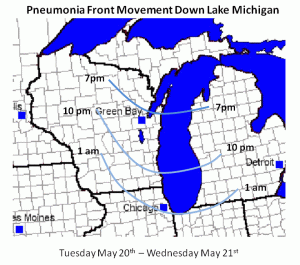
U.S. National Oceanic and Atmospheric Administration
“Pneumonia front” jumped out at me from the (web) pages of the Chicago Tribune last week when the U.S. National Weather Service reported a front moving from the north toward the Chicago area that was expected to drop temperatures by 20 degrees (F) within minutes, spawning thunderstorms.
Pneumonia really has nothing to do with it, except to play on the old saying that “you’ll catch your death of cold” if not dressed warmly enough. As pneumonia fronts generally occur in the spring and summer, a dramatic drop in temperature in likely to leave one inadequately dressed for the cold. Continue reading →
The 500-word universe? Globe and Mail bucks trend with 5,000-word feature

credit: Pixelbliss
“Citius – Altius – Fortius” — faster, higher, stronger — is the motto of the Olympics. But reporters are fearing that journalism’s new motto is “Citius – Brevius – Debilius” (faster, shorter, weaker) since the wire services Associated Press (AP) and Reuters each sent memos earlier this month to staff urging directing them to keep their stories short. Very short.
The edicts had mixed reviews among journalists, but many lamented the shortening, over-simplifying and loss of autonomy they represent. Continue reading →
Word Watch: themmie
“Themmie” is a word Ben Yagoda (professor of English at the University of Delaware) has suggested for someone taking a selfie:

Pollen in the public domain
 Nineteenth-century German illustrations of pollen “in extreme magnification” have recently entered the public domain.
So reports the Public Domain Review, an online journal and not-for-profit project whose organizers keep their eyes peeled for material that is no longer protected by copyright.
The illustrations, one page of which is on the left, appeared in Ueber den Pollen (1837), a book by St. Petersburg-based German pharmacist, chemist and botanist Carl Julius Fritzsche (1808-1871). Continue reading →
When radiologists take a selfie…
 Radiologists? Radiographers? Both?
Not earth-shaking — just a little fun.~TM
Pain relief is on the way — or the design, anyway

Neurons in sizzling black and red, representing facial pain
The new design representing pain relief — which will adorn neckties and scarves from Infectious Awareables (IA) is on the way.
Or, more correctly, two designs are on the way.
You may recall that in February, Dr. Roger Freeman (DDS), of IA, put out a call (which ran here) for suggested designs representing pain relief, as a follow-up to a custom design the firm produced last year of facial pain design in collaboration with TNA-The Facial Pain Association and its research division, the Facial Pain Research Foundation, organizations dealing with neuropathic face pain including trigeminal neuralgia. Continue reading →
Word Watch: pollen vortex
 Hot off the press! Canadian Word Spy Paul McFedries was very quick off the mark to note this one, following on the heels of this winter’s polar vortex.
A “pollen vortex” is the high levels of spring pollen that are created when temperatures rise quickly following an extremely cold winter. Given the recency of “polar vortex,” it’s not surprising that the earliest citation McFedries found was just over a month ago on Twitter, tweeted by Marc Santia, a reporter for WNBC-TV in New York.
Since then, it’s appeared in Mother Jones magazine as well as the Washington Post.~TM
Word Watch: gluten-freegan
 Canada’s Word Spy Paul McFedries has identified another new term: “gluten-freegan,” meaning someone who eats a gluten-free, vegan diet.
The earliest citation appeared in a Salt Lake City restaurant review on the Goldteef blog.
Another use appeared in the Post Punk Kitchen Forum in 2011. The heading – “flexitarian, seagan, beegan, etc.” – raised a host of other questions.~TM
NEWS: Drug prevents measles in animal model; seen as adjunct to immunization

Credit: kreizihorse
Researchers in the U.S. and Germany have developed a drug that may prevent vulnerable people exposed to measles from getting the disease.
They have successfully tested the drug against a virus similar to measles (canine distemper virus, or CDV) in ferrets, in which it is invariably fatal. Ferrets given the drug prophylactically and then infected intranasally with a lethal CDV dose had lower viremia and prolonged survival, they reported today in Science Translational Medicine (16 April).
Ferrets infected with the same dose of virus and treated at the onset of viremia showed low-grade viral loads, remained asymptomatic, and recovered from infection, whereas control animals succumbed to the disease.
Animals that recovered also mounted a robust immune response and were protected against rechallenge with a lethal CDV dose, they added.
The findings suggest the drug can not only treat measles in the early stages, but prevent disease in the social and household contacts of those with measles. Continue reading →
 Murray's Review of Medical Journalism