Verification Handbook now available for download
 The Verification Handbook, a resource for journalists providing guidelines for sifting through information on social media during a crisis (and reported here on Murray’s Review on 30 January) is now available for download.
When first launched by the European Journalism Centre, the book was available online only, but can now be downloaded in PDF, ePub and Kindle versions.
Word Watch: How long do new words last?
 New words enter the lexicon daily, but how long do any of them last?
“To adapt a biblical comparison, it seems easier for a camel to go through the eye of a needle than for a new word to take residence in the permanent vocabulary of a language,” according to Dr. Allan Metcalf (PhD), professor of English at MacMurray College in Jacksonville, Ill. and an occasional contributor to the “Lingua Franca” blog of The Chronicle of Higher Education.
“I can confidently say that the odds of a neologism becoming part of our permanent vocabulary are not nearly as long as the odds of winning half-a-billion dollars with a Powerball ticket,” Dr. Metcalf wrote in a 2012 post, in which he reviewed the factors he has identified as contributing to the longevity of new words:
- Frequency of use
- Unobtrusiveness
- Diversity of users and situations
- Generation of other forms and meanings
- Endurance of the concept
If the wording of that list seems a bit — how shall we say? “tortured”? — he said he arranged them to spell FUDGE. Before you roll your eyes, keep in mind the similarly tortured (and worse) names of some clinical trials.
The most important of the five factors, Dr. Metcalf said, is unobtrusiveness. “Consciously-coined neologisms generally are in-your-face with cleverness or humor,” he wrote. “We admire and laugh at them, but we don’t adopt them. Sometimes, though, the cleverness and humor are forgotten, and a once-funny term becomes permanent.”
Keep these FUDGE factors in mind as new words and phrases appear in posts headed “Word Watch” here.
Toronto Star doesn’t understand clinical trials
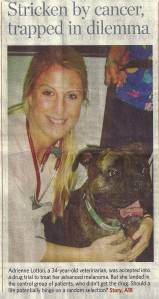 The Toronto Star has good medical reporters, but none of them wrote the front-page story in Saturday’s paper that showed an almost-total lack of understanding of clinical trials.
I know better than to judge an entire story by a headline — or in the case, a cutline (commonly known as a caption) on a Page One picture. I hoped this cutline (newspaper-speak for the text below a photo; a “caption” is the photo’s “headline”) was just meant to draw me into the paper, where the full story actually appeared on page A18:
“Adrienne Lotton, a 34-year-old veterinarian, was accepted into a drug trial to treat her advanced melanoma. But she landed in the control group of patients, who didn’t get the drug. Should a life potentially hinge on a random selection?” Continue reading →
Surgeons propose ‘slipperiness score’ for winter weather reports

Dr. Kevin Chung
The plethora of meteorological indexes — wind chill factor, humidex, UV index, air quality index, pollen counts — may have to make room for a new “slipperiness score” proposed by clinicians at the University of Michigan.
The researchers, led by two surgeons, analyzed a sample of U.S. Medicare claims from 2007 for distal radius fracture (a cohort of 21,507 patients, or 25% of all of Medicare beneficiaries with distal radius fractures that year) and correlated the diagnoses with weather data for the date and location of each injury in the cohort.
From that analysis, they devised a novel “slipperiness score,” from zero to seven, for the severity of slippery weather conditions. Continue reading →
Globe and Mail’s mea culpa ( sort of ) for homeopathic flu advice
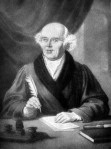
Samuel Hahnemann
Founder of homeopathy
The Globe and Mail took a bit of flak last week for a “Health Advisor” blog post by a homeopath on “Eight easy, natural ways to keep the flu at bay.”
Today, the Globe‘s public editor Sylvia Stead issued a mea culpa of sorts. In her article, she noted that the blog post had “garnered criticism” in six of the eight comments posted to it and on social media. The criticisms were that the recommendations of Bruce Wylde, the blogger in question — including raw onion juice, honey, garlic, probiotics and an “immune-boosting” soup containing astragalus root, shiitake mushrooms, onions and tumeric — lacked evidence.
“I think there should be a bias toward medical professionals writing about medicine and, while there is room for some coverage on alternative or homeopathic treatments, care should be taken to always balance such coverage with a doctor’s or other medical professional’s experience and expertise,” Stead wrote in the column titled “Homeopath’s advice needs to be balanced.” Continue reading →
Happy 94th birthday, Joan Hollobon!

Joan Hollobon
at her 90th birthday party
Yesterday was the 94th birthday of Joan Hollobon, who some among you may remember as the Globe and Mail‘s medical reporter from the early 1960s until her retirement in 1985.
Joan, whose career spanned the founding of Medicare to the early days of the AIDS pandemic, was also a founder of the Canadian Science Writers Association, which awarded her its first lifetime achievement award in 2010.
I’m posting this late because I had lunch and spent the afternoon with her yesterday. She’s become quite frail, but remains interested in the health-care system and medical reporting. And she still doesn’t suffer fools gladly.
How to dry your hands with one paper towel
Then along comes Joe Smith, a lawyer and sometime state politician in Oregon. In 2012, he gave a TEDx talk about how to dry your hands after washing them in a public washroom using only one paper towel, even the flimsy recycled kind, thus saving millions of pounds of paper towel a year. Continue reading →
Sifting truth from rumour on social media
 The European Journalism Centre (EJC) has launched The Verification Handbook, a resource for journalists, providing guidelines for sifting through information on social media during a crisis.
“In a crisis situation, social networks are overloaded with situational updates, calls for relief, reports of new developments and rescue information,” the EJC said in releasing the book online. “The handbook prescribes best practice advice on how to verify and use this information provided by the crowd, as well as actionable advice to facilitate disaster preparedness in newsrooms.”
For the moment, the handbook is available online only, but print, ePub and free PDF versions will be available “soon,” the EJC said.
Obituary: Dr. M. Therese Southgate

Dr. M. Therese Southgate
Norris McNamara
Although it occurred on 22 November, we felt it was important to note the death of Dr. M. Therese Southgate, best known as cover editor of the Journal of the American Medical Association (JAMA).
Dr. Southgate, 85, died at her home in Chicago after a short illness.
She earned an undergraduate degree in chemistry at what is now the University of St. Francis in Joliet, Ill., and worked for a time for a magazine covering the chemical industry before deciding to go to medical school, according to her obituary in the Chicago Tribune. She graduated from the Marquette University School of Medicine (now Medical College of Wisconsin) in 1960, and completed a rotating internship at St. Mary’s Hospital in San Francisco before joining the JAMA staff in 1962.
Her first position was as senior editor — the first time a woman had held that job. Two years later, JAMA editors made the “bold and unprecedented decision” to feature fine art on the journal’s cover. In 1974, Dr. Southgate was promoted to deputy editor and began to select the art and write an accompanying essay, according to JAMA’s report of her death. Continue reading →
‘Dr.’ style
 People who have earned MDs (and British equivalents), PhDs, DVMs, DDSs, ScDs, DCs, JDs and other similarly advanced academic credentials all want to be called “doctor,” with the accompanying “Dr.” honorific or courtesy title.
But publications — daily newspapers, professional magazines and journals — have different policies on who is entitled to the “Dr.” title, with the result that some people feel hard done by when they’re left out. Continue reading →
 Murray's Review of Medical Journalism